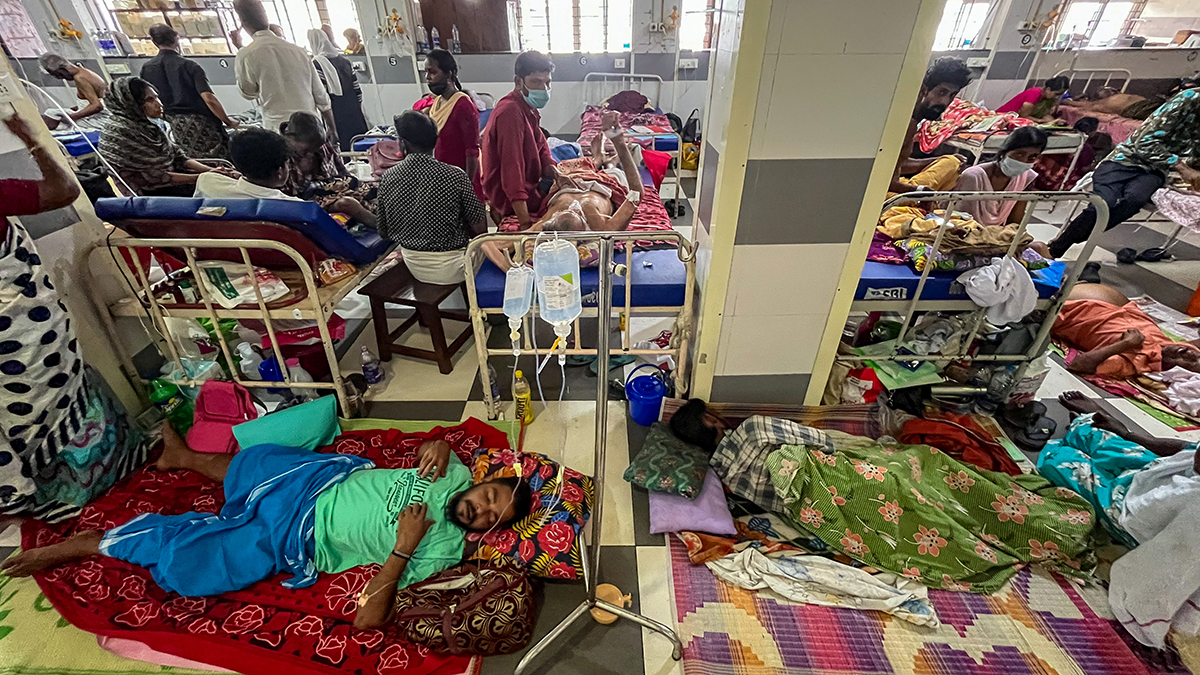
Kerala is considered the ‘healthiest Indian state’ based on certain health indices, comparable with those of world’s healthiest Scandinavian nations. Kerala’s unique achievement has been attributed to a time-tested primary healthcare dispensed by well-entrenched public healthcare sector. Primary Health Centres, and larger District, Taluk, and teaching hospitals have been in the forefront of neonatal and antenatal vaccination and targeted antenatal care. These simple initiatives, along with safe obstetric services significantly brought down Maternal Mortality, Infant Mortality Rates, and boosted Life Expectancy at birth. Public health sector promoted family planning through education, creating awareness and conducting free camps providing surgical birth control procedures.
Kerala’s 100% literacy complemented the Healthcare sector. Schemes like Midday Meal Scheme added to child nutrition. Religious adherence to Universal Vaccination Programme prevented childhood infectious diseases. Stringent regulations checked female feticide. Gender ratio favoring girl children resulted. Participation of small clinics and multi-specialty hospitals managed by various faiths, especially the Church complemented the public sector. These institutions, which provided quality healthcare at menial rates addressed rural healthcare requirements. Kerala’s achievements in healthcare, which reflected in her health indices won her global and WHO’s recognition.
Soon, an irony unfolded in the state. Superior Healthcare delivery, especially primary healthcare, complemented by 100% literacy crowned Kerala with highest life expectancy at birth (78.26), against the nation’s 72 years. Increased life expectancy resulted in an overwhelming elderly population with associated comorbidities (medical conditions viz; hypertension, diabetes, vascular diseases like stroke, myocardial infarction, end-stage organ failure), malignancies, and degenerative neurological diseases like Parkinsonism and dementia. Musculo-skeletal injuries following fall, and psychological issues like depression, anxiety and often suicidal tendency .
Soon, Kerala’s superior healthcare sector which excelled in providing primary and secondary healthcare had a mountain to climb- financially and technologically vastly demanding, and infrastructure-heavy tertiary healthcare. Cash-strapped state governments failed to rise up to the changed scenario. 1.74% budgetary allocation for healthcare by the current government is too measly. The cash-heavy private sector, captained by the corporate sector sensed a goose that lays golden eggs in Kerala’s changed healthcare demands. Corporate private hospitals mushroomed across the state providing much -needed tertiary healthcare. Cash-rich hospital managements invested big-time by themselves, and by collaborating with foreign healthcare behemoths to meet Kerala’s unique healthcare needs. Healthcare turned a flourishing business in Kerala. The now well-founded corporate sector had well-trained manpower already existing in Kerala to staff the sector, which found takers among Kerala’s elderly sick, left to fend for themselves by families migrating to greener pastures on foreign shores.
Kerala’s clinicians, surgeons and physicians have a yoke to bear- to treat elderly patients affected by multiple organ failures. This demands well-equipped ICUs and operating suites. Co-existence of Life-threatening diseases in patients requiring surgery merit fine tooth-combing with state-of-the-art pre-operative investigations. All these translated to huge investments in healthcare, which the cash-strapped government couldn’t afford.
Soon, a booming corporate sector capable of providing healthcare of international standards at cheaper costs, compared to developed nations made Kerala a favorite destination for ‘healthcare tourists’. Availability of state-of-the-art healthcare dispensation had even the common people of the state approach the corporate sector, though unaffordable to them.
While Kerala’s superior healthcare dispensation is a favorite of healthcare ‘tourists’, it remains Holy Grail for local citizens, while those in governance cross the seas for healthcare needs.
Three recent incidents exposed Kerala’s gasping public healthcare sector, meriting critical care.
In the first, Head of Urology Department in Kerala’s oldest Government Medical College Hospital in Thiruvananthapuram took to face book to air his grouses about his department’s functioning. His grouses were numerous to be ignored by the government he served, and the opposition, looking for excuses to pounce on the government. He complained of shortage, and poor quality of medical equipment leading to postponement of scheduled surgery. Alerting authorities of the precarious situation fell on deaf ears. He complained in the face book post he later deleted at the insistence of a friend, who was also a leader of CPM, the party governing Kerala. The government led by the Health Minister and Director of Medical Education pleaded innocence of complaints earlier raised by the doctor. With their backs to the walls, hemmed in by the opposition, the government accused the complaining doctor of selling medical equipment. Witch-hunting the whistleblower doctor reached a zenith when it was charged that equipment worth Rs. 20 lakhs purchased utilizing Thiruvananthapuram MP’s development allocation was missing from the Urology Department.
Before smoke could settle on the unsavory incident at the state government’s premier teaching hospital, a portion of the 68-year-old government Medical College at Kottayam collapsed killing a woman, and injuring two trapped under the debris. The collapsed portion consisted of a scarcely-used bathroom complex attached to ward 14. Customarily following the incident, opposition political parties indulged in blame game, as promptly as the government searched for a fall guy. The hospital Superintendent, who also happened to be the head of Cardiothoracic Surgery, fitted that bill. Dr. Jayakumar TK, a truly people’s doctor known for his dedication as surgeon and integrity as Superintendent had the backing of Kerala’s sick who had received his undiluted, dedicated and sincere care, which had the government fish for another convenient scapegoat.
After these incidents, news of a portion of the compound wall of Government medical College at Calicut collapsing was found in the remote corner of newspapers. This incident near the Dental College section did not throw up much political dust, as only a few cars parked nearby were damaged.
Feathers in the cap of Kerala’s once much-acclaimed healthcare seemed to be jinxed. All these incidents showcased the poor state of Kerala’s cash-strapped public healthcare sector.
What is the way out? As long as the government refuses to allocate better funding for public healthcare sector, the public must decide to finance the same by paying for outpatient consultations voluntarily. Humongous funds thus collected can be used for upgradation of cash-strapped public healthcare sector.
That it was at Kottayam Medical College Hospital that the first heart transplantation in Kerala’s public sector was performed by Dr. Jayakumar, showcases the talent abounding in the sector, which lacks infrastructure and cutting-edge technology the private sector is richly blessed with.


Leave a Reply