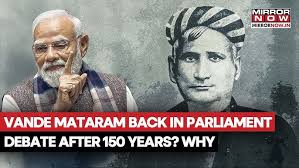
The poem Vande Mataram, penned by Bankim Chandra Chattopadyay is a salutation of India imagined as mother. It inspired generations of nation-builders who united diverse sections of society to wrest freedom from British colonialism. The colonial government piqued by nationalistic fervor and patriotism the poem elicited across the country, declared its public recital criminal. Many independence activists were imprisoned by the colonialists for violating the dictat.
The first two verses of Vande Mataram make abstract reference to the ‘mother’ and ‘motherland’, without any religious connotation. However, later verses mention Hindu Goddesses such as Durga, which became a bone of contention in 1937. The Indian National Congress on suggestion of Mahatma Gandhi and Rabindranath Tagore adopted the first two stanzas of the poem. The alteration of the poem was part of the official resolution of the Congress Party’s Working Committee (CWC) that met in Calcutta on October 30, 1937. The CWC had Jawaharlal Nehru chairing the session. It was attended by stalwarts including Sardar Valabhbhai Patel, Rajendra Prasad, Maulana Abdul Kalam Azad, Bhulabhai Desai, Jamnalal Bajaj, Acharya JB Kripalani, Pattabi Seetharamaiah, Rajaji, Acharya Narendra Dev, Jayapakash Narayan, and Netaji Subhash Chandra Bose.
Though Mahatma Gandhi was not a member of the CWC, he, as a special invitee finalized the wording of the resolution, which was moved by Rajendra Prasad and seconded by Sardar Patel.
The unanimous resolution read thus ‘the Working Committee has given careful consideration to the question that has been raised in regard to the Congress Anthem “Vande Mataram”. This song has a historic background and has evoked deep enthusiasm and powerful sentiment in the course of our struggle for freedom. It has thus acquired a unique place in the national movement. The Committee recognizes the validity of the objections raised by Muslim friends to certain parts of the song. While the Committee has taken note of such objections in so far as it has felt justified in doing so, it is unable to go any further in the matter. The Committee recommends that wherever the ‘Vande Mataram” song is sung at national gatherings, only these two stanzas should be sung, and the version and music prepared by Rabindranath Tagore should be followed. The Committee trusts that this decision will remove all causes of complaint and will have the willing acceptance of all communities in the country.’
Why write on ‘Vante Mataram’ now? Why revisit the great poem which fuelled the freedom movement at this juncture? Years after I, as a schoolboy had sung it along with the national Anthem Jana Gana Mana, and the pledge on numerous school assemblies? And have listened to it being rendered on observance of numerous independence and Republic days on mainstream media then, and social media, now?
The writing was necessitated by the decision of the present ruling disposition in Delhi to debate on Vande Mataram on the 150th anniversary of the song, 78 years after freedom was won! During the Winter Session of Parliament recently. It appeared as though the current central government desperately needed something to tug at, to haul itself out of uncomfortable debates on numerous other important issues impacting the country when the Winter Session was in progress. The government had to face the opposition’s uncomfortable persistent needling and citizens’ search for answers on the mayhem witnessed in Indian skies on account of the grounding of over thousand aircrafts by the country’s largest airline IndiGo, throwing air travel into an unparalleled commotion during the festival season. The government had also to answer uncomfortable questions the opposition raised on the Special Intensive Revision of electoral rolls, a cunningly camouflaged exercise by the government to render considerable number of citizens disenfranchised.
Two persons adequately equipped with lung power and audacity to spew venom in the current Parliament decided to go on the offensive mouthing vitriol and irrelevant narrative on Vante Mataram. As though the political party they belonged to- the BJP had exclusive copyright to Vante Mataram. As though those who decided to modify the poem were mere nincompoops compared to the smart alecs of modern-day Indian politics. The song was created much before the wise brains of today were even conceived as politicians in free India.
The Prime Minister, during the ill-timed debate on the poem manifested the perennial ‘Nehru itch’ he and his party are famously and curiously suffering from. The BJP blames Nehru for everything- from the country’s geography to her citizens’ biometric specifications.
Observation of 150th anniversary of Vande Mataram was utilized to the hilt to throw stones at free India’s first Prime Minister. A historical fact that strangely causes indigestion and anaphylaxis to the BJP and its various sister concerns that constitute the Sangh Parivar. Especially the RSS. Unfortunately, history is history whether they like it or not. Nehru was, and will remain India’s first, and one of the most beloved Prime Ministers, unlike some of his successors, and Mahatma Gandhi the Father of independent India, while a certain Nathuram Godse, the RSS goon will languish in the depths of Indian history for murdering the nonviolent freedom crusader for reasons best known to him and his organization.
Commemoration of 150th anniversary of Vande mathram was an extension of BJP’s favorite political pastime- Islamophobia. A drum roll to whip up majoritarian frenzy to garner votes. A Reiteration of Their politically convenient version of ‘nationalism’, modeled on shredding asunder along religious lines. And yet another attempt to throw stones at politicians like Nehru for ‘appeasing minorities’ (read Muslims). An accusation BJP and the Sangh Parivar has adopted as their political anthem.
The Sangh Parivar seem oblivious of the fact that Mataram or ‘mother’ they would like to consider India as, and pretend to pay obeisance to, is being regularly meted out reason to grieve. To shed many a tear, and taken for a ride in the process. When the mother’s children are torn asunder along lines of faith. When her children trading in, and consuming beef are lynched. When federalism is sacrificed at the altar of petty politicking. When states governed by the opposition are considered urchins and served step-motherly treatment. When democracy, which nourishes the mother is tarnished in Parliament, when the opposition is denied rightful opportunity to debate and raise issues relevant to national growth, and irrelevant (read uncomfortable) to the government. When institutions in the country which forms the mother’s limbs are dismembered for misuse to get at the opposition. When people expressing different opinion or dare to criticize the government are either banished to the dungeon or hunted like wild dogs. Such instances are dime a dozen in modern India. Debating on the poem in such circumstances makes a fool of the mataram (mother). It also reduces debating on Vande Mataram to a mere ritual shorn of any semblance of well-meaning or noble intention.
Going by the pitiable state the hapless Mataram has been relegated and reduced to, and taken for a jolly good ride, debating on 150th anniversary of a poem eulogizing the mother they care two hoots for, by itself reeks of hypocrisy and a political stunt the mother herself would love to distance herself from.
 Writer By Chance.
Leave a comment