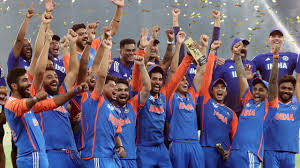
Cricket’s 2025 version of Asia Cup is done and dusted. On September 28 2025 India faced archrivals Pakistan in the finals. The Dubai stadium was packed to capacity with cricket-crazy fans painted all over either with Indian tricolor or star and crescent in green background. It was yet another cricketing ‘war’ fought with the usual fire in the belly, vitriol and distinct ferocity. The floodlit stadium reverberated with war cry omnipresent whenever the sub continental cricketers took on each other.
The finals of the tournament played in T20 format saw India batting second chasing a total of 146. Going by the berserk manner in which Pakistani openers blasted Indian bowlers all around the stadium and over it, it seemed possible that Pakistan would post at least 175. That’s when Indian spinner Kuldip Yadav tamed the Pakistani batsmen by scalping 4 of them. They were ultimately limited to 146. 146 suddenly seemed a mountain to climb when Pakistani bowlers led by Shaheen Afridi sent back the Indian top order cheaply. Dressing room-to-pitch procession of Indian batsmen who constituted a ‘strong and deep’ batting lineup (at least on paper) followed. It was a pressure cooker atmosphere that night, integral with every Indo-Pakistan cricket match. It took a determined and disciplined trio of man-of-the-match Tilak Varma, who scripted 69 from 53 balls, Shivam Dube and Sanju Samson to help India to her 9th Asia Cup title.
What struck me as an avid cricket fan was the manner in which Indian cricketers, who ultimately won the tournament by turning blood to sweat in Dubai’s humid conditions were treated as mere toys by politicians back home through one of centre’s many handmaidens, the Board of Cricket Control of India (BCCI).
Pakistan-trained terrorists had gunned down 26 Indian tourists in Pahalgam in India’s Jammu and Kashmir only on April 22 2025. Since the madness, political ties between the two sub-continental neighbors soured badly. India retorted through Operation Sindoor, an armed exercise intended to take apart terror factories deep inside Pakistani territory. Besides, diplomatic exercises followed to tighten screws on the incorrigible shrew across the LOC. India suspended the Indus River Treaty with Pakistan, denying precious water to the habitual offender. The Indian subcontinent could never have been closer to full-fledged war between the two nuclear-powered neighbors.
It was against this unsavory background that the bitter neighbors met on a cricketing pitch at the Asia Cup Tournament in Dubai. It was after much dilly dallying that the BCCI confirmed India’s participation.
At every match between teams representing the inimical neighbors in various stages of the tournament, including the finals, the players refused to shake hands between them. This gesture is not mandatory. Handshakes are exchanged between the victor and vanquished to augur sportsmanship. The captains refused to shake hands at the toss, also an act of friendship and bonhomie.
Worse, the victorious Indian team refused to accept the Asia Cup trophy they won by beating Pakistan by 5 wickets, as the silverware was to be awarded by Mohsin Naqvi, President of the Asian Cricket Council. Naqvi was also Chairman of the Pakistan Cricket Board, and Pakistan’s Interior Minister. The victorious Indian team stood away from the presentation stage on which Naqvi stood too, refusing to accept the coveted trophy from him. A piqued Naqvi walked away to his hotel room with the unclaimed cup, and medallions meant for the victorious Indian cricketers!
It seemed possible that Indian cricketers were enacting a drama scripted by the BCCI, to behave in a manner sillier than kindergarten kids, as Indian fans in the stadium screamed ‘Bharat Mata ki jai’, and the Pakistani captain threw away the runner-up prize money cheque.
If India wasn’t emotionally and sentimentally prepared to play Pakistan in the tournament immediately after the Pahalgam incident, why did BCCI consent to take part in the tournament in which India would have to meet Pakistan anyway? The country would have respected a decision not to play Pakistan taken by the BCCI under the circumstances.
By instructing the players to behave in a silly manner hitherto unseen in a cricket stadium, it made sheer monkeys out of them, when they represented the nation in an international tournament. The BCCI treated them like programmed robots to suit its political agenda. To whip up the neo-version of ‘nationalism’. The center, through BCCI intended to rub in Operation Sindoor’s spectacular success to the nation’s psyche by sacrificing the cricketers at the altar of South Asian politics. As long as the BCCI was yet another kitchen crew of the central government, like many other institutions, it was supposed to obey its boss’ orders. Little did the master and the slave realize that nationalism shoved down the gullet would only regurgitate sooner than later. After all, the entire citizenry of the country aren’t fools like them.
Sad to say, Indian cricketers and cricket were misused by the government to get back at its bête noire Pakistan. Sadder, Indian cricketers who were mere pawns in the hands of politicians were made to look stupid, silly, shorn of character, and slavish. If not, would Indian captain Surya Kumar Yadav have dragged the team into the vertex of the geopolitical cesspool, by deciding to donate his entire match fees from the tournament to support Indian armed forces, and families of the Pahalgam terror attack, whose sentiments and sensibilities he had no second thoughts about? Who was he trying to appease by politicizing cricket like never before?
Indeed the captain and the players have to bear the onus of letting themselves be reduced to mere puppets in the hands of crafty marionettes that politicians are. After all, they are 11 men skilled in playing cricket for the country, and not buffoons in a circus ring.
Could things have been better when Jay Shah, son of the Indian Home Minister is closely associated with Indian cricket officially?
When Prime Minister Modi wrote on X the next day ‘#Operation Sindoor on the games field. Outcome is the same-India wins!’, everything fell in place.
At the time of writing, BCCI is calling Mohsin Naqvi names like ‘cup choree’ (cup thief) for walking away to his hotel room with the Asia cup trophy and Medals meant for the victors. Indian women cricketers taking part in the ongoing Women’s World Cup have taken off from where their male counterparts left off at the Asia Cup by looking the other way before Pakistani players, in every Indo-Pakistan encounter in the tournament.
Can sport be please freed from the influence of immature politics? But then, who will bell the cat?
 Writer By Chance.
Leave a comment